Is Your M&A Function Ready for AI, and Will It Actually Help?
The odds are high that some part of your M&A organization is using AI, or experimenting with it. The odds are iffy that you are seeing clear benefits yet.


96% of dealmakers use AI for sourcing and screening targets.
Only one in three have assessed their deal process to optimize for AI adoption.
Only ~12% of large acquirers are programmatic, with a deal process that is well-defined in the first place.
Why does this matter? The gap between acquirers that drive deal ROI repeatedly and those that cannot is widening fast, and AI-enabling your M&A team will not automatically enable success. Without a defined process ready for AI, the benefits you are hoping for will be elusive to achieve and difficult to measure.
On sourcing: the first figure is Datasite’s, from a survey of 1,000 senior dealmakers across 27 countries fielded in March. The second is Bain’s 2026 M&A Report. The third is McKinsey’s, from a February survey of 878 executives, and it is a proxy rather than a direct measure. Nobody publishes a count of how many acquirers run a defined, repeatable deal process, which is itself part of the problem. That same survey found programmatic acquirers 2.1 times more likely than peers to have strong operating model capabilities, widening from 1.7 times in 2021, and twice as likely to have a dedicated integration team.
Which reframes the question. Almost nobody in corporate development is still deciding whether to use AI. The questions actually on the table are whether it is working and where to push it next. Neither is answerable by looking at the tool.
The adoption curve and the impact curve are not the same curve
The wider enterprise is already learning this the expensive way.
McKinsey’s State of AI survey, covering nearly 2,000 organizations, found 88% using AI in at least one business function and only 39% reporting any enterprise-level EBIT impact at all. Around 6% qualified as high performers, attributing more than 5% of EBIT to AI. PwC’s 2026 CEO Survey found 56% of chief executives reporting neither higher revenue nor lower costs from AI over the prior twelve months, against 12% reporting both.
None of this is a story about bad technology. The demos work. The pilots produce output. The output does not reach the income statement.
M&A is running the same experiment with the same shape. Adoption more than doubled in 2025, to 45% of Bain’s 300-plus M&A executives, and it clustered where it was easiest to start: sourcing, screening, and document-heavy diligence. Note the distance between that 45% and Datasite’s 96%. One measures the full deal cycle; the other measures the single easiest point of entry. Post-close integration, where lean teams are under the most strain and where deal value is won or lost, remains the least touched part of the cycle.
One variable predicts whether AI pays
McKinsey tested 25 organizational attributes against whether a company saw EBIT impact from generative AI. Of everything measured, workflow redesign had the largest effect. Roughly a fifth of companies redesign workflows end to end. Among high performers, that share was 55%, against about 20% everywhere else.
PwC puts the split plainly: technology delivers about 20% of an initiative’s value; redesigning the work delivers the rest.
The most recent read is blunter. Futurum Research surveyed 820 enterprise AI decision-makers in the first half of this year, and the practitioner panel accompanying it described agentic AI failing when it is laid on top of an operating model nobody changed, and succeeding when the underlying process is rebuilt around it.
Which returns us to Bain’s one-third. Ninety-six percent adoption at the front of the funnel. Roughly a third who assessed the process at all. The rest bought capability and left the work arranged exactly as it was.
Why “let’s get the M&A team AI-enabled” is a debatable mandate
The first reason is that it overlooks prerequisites. A process has to be defined before you can apply a tool to optimize it. To get real business impact you usually have to rethink it, which requires understanding where the workflow gaps and inefficiencies sit today.
Those prerequisites are hard for any function. In M&A they are harder. Most acquirers have poorly documented lifecycle workflows, and most do not track the recurring issues that end up eroding deal ROI. Transactions are inherently non-standard work compared to the daily rhythm of operations. Lean team sizes and a heavily matrixed set of deal stakeholders, most of whom are not dedicated to M&A, make it extra tough to build the muscle memory a repeatable playbook requires.
The second reason is the word “team.” Defining it is what tells you who needs to get enabled and which benefits matter most. On a large share of deals, many of the people executing diligence and integration are not part of a dedicated M&A function, and some are temporary external resources. Whether your workstreams are run by dedicated staff, by business SMEs borrowed part-time, or by a consultant through Day 100 decides who has to be enabled for any benefit to reach the deal at all.
Enable the upstream phase while execution sits elsewhere and you get a faster intake attached to a deal lifecycle with all the same issues. Possibly compounded, if accelerated origination puts more pressure on downstream teams.
Three patterns, with differing signals
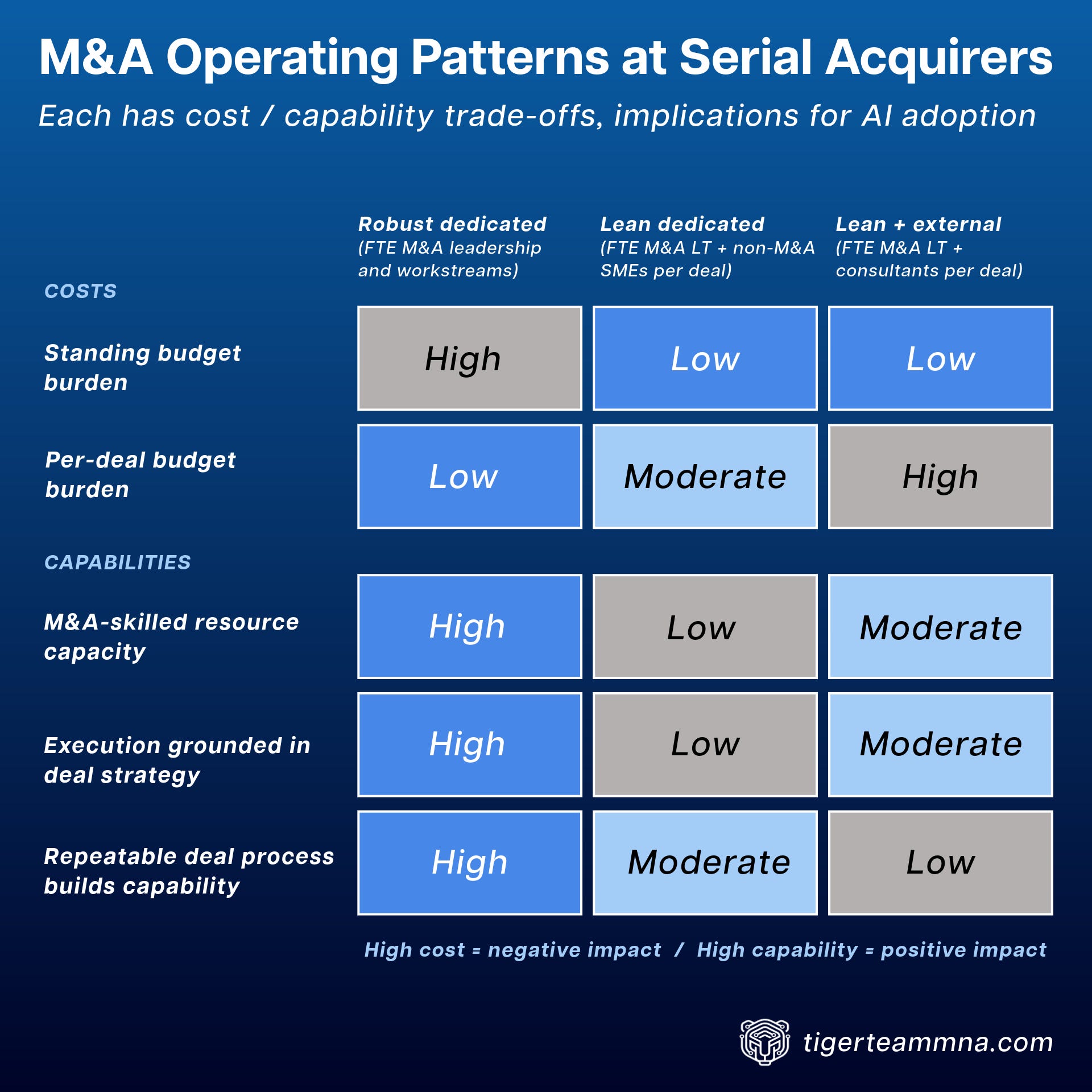
Serial acquirers staff M&A in roughly one of three ways. None of these is a maturity level. They are different strategies for budgeting and staffing around the episodic nature of M&A.
1. Robust dedicated. Dedicated FTE resources for both M&A leadership and M&A workstreams. Business-function SMEs contribute inputs to diligence and integration assumptions, but dedicated M&A staff carry the bulk of deal project work.
2. Lean dedicated. Dedicated FTE resources for M&A leadership, with execution heavily reliant on business-function resources borrowed part-time per deal. Those people have a day job they are actually measured on.
3. Lean plus external. Dedicated FTE resources for M&A leadership, heavily reliant on external consultants engaged per deal to support workstreams and sometimes to drive the IMO. The engagement typically hands the deal to the business and rolls off around Day 10.
Each model carries a different set of cost and capability tradeoff
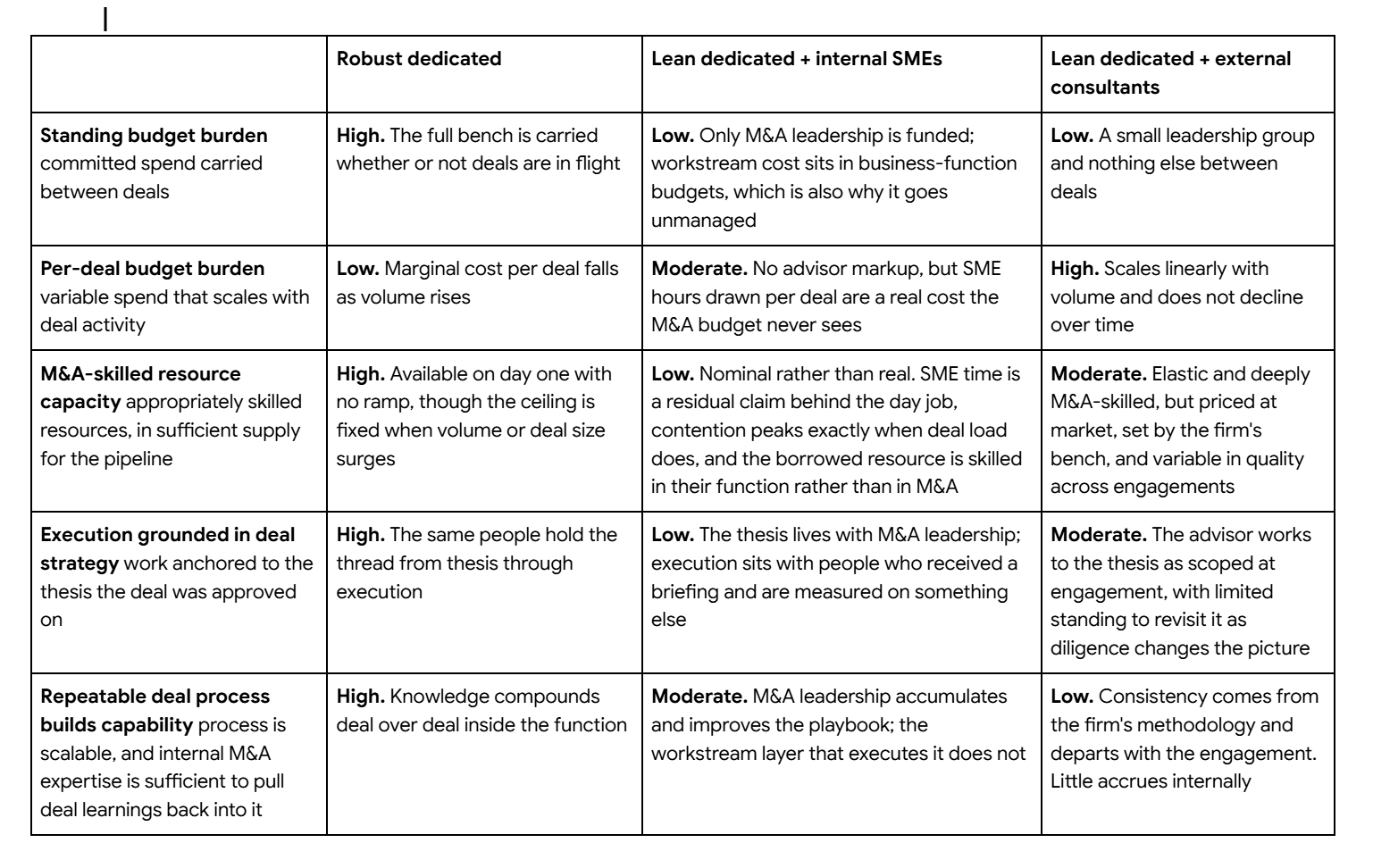
Two things stand out reading across. The first two rows invert against each other, making robust dedicated and lean plus external economic mirror images. And the two lean patterns, which most acquirers now run, buy their lighter standing cost by giving up different capabilities: lean dedicated loses M&A skill at the point of execution, and lean plus external loses what should have accumulated afterward.
Those trades decide what an AI implementation can reach, what has to be true first, and which of the pattern’s own gaps it should be aimed at.
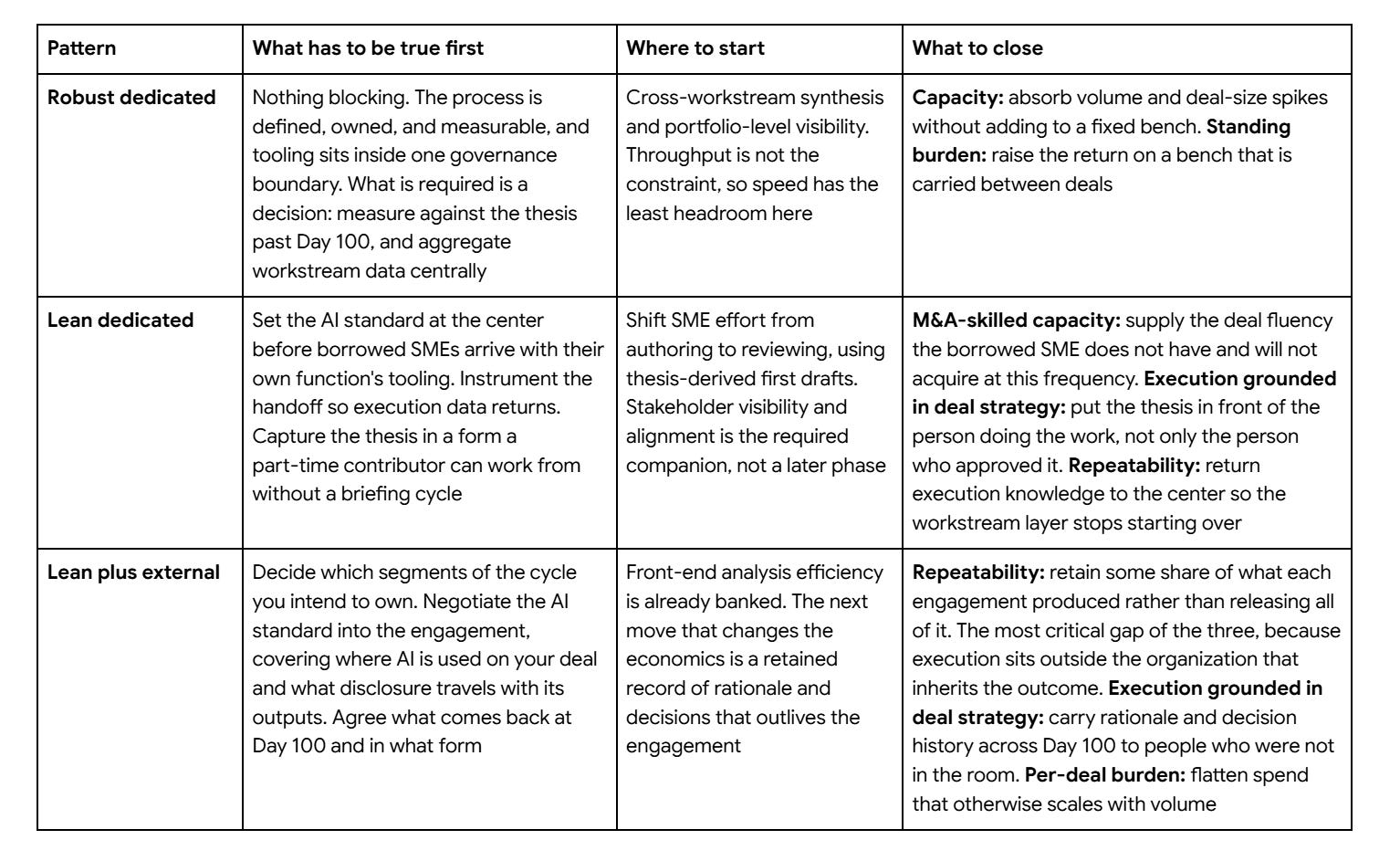
Read across both tables and the same two capabilities keep surfacing: execution grounded in the deal strategy, and a repeatable process that builds capability. They are the weakest points in the two patterns most acquirers actually run, and they are precisely what speed-oriented tooling does nothing for.
One condition that applies to all three
Whatever the pattern, AI enablement for deal work has to be governed by the core M&A leaders.
Otherwise you get process proliferation. Business functions supporting deals part-time arrive with their own function’s AI stack; external consultants arrive with their firm’s. Neither is calibrated to this deal’s thesis or to your process, because neither was built for it. The result is siloed tooling applied to segments of a cycle nobody owns end to end, producing outputs of uneven accuracy and inconsistent provenance. That compounds the two problems you were already solving for: the deal process gets more confusing, and coordination degrades at exactly the handoffs where it was already weakest.
The advisor (consultant) case is the trickier one. Their AI stack is a commercial asset they are actively differentiating on, so tooling choices follow their economics rather than your process. Governance there has to be negotiated into the engagement, not assumed.
Two questions before you deploy
Does the tool just bring speed, or can it support judgment?
Speed is the easy sell and the weakest claim. Screening more targets faster is real, but volume was never the binding constraint on deal value, and a tool that compresses a task cannot be graded on deal outcomes because the deal’s thesis was never one of its inputs.
Ask the tool instead what a diligence finding means for a specific deal’s value case. A tool that reasons from this deal’s rationale and context can answer. A tool that runs the same motion on every deal cannot, and never could.
Datasite’s respondents effectively drew this line themselves. Asked which attributes are hardest for AI to replicate, they named negotiation and relationship management, strategic judgment and prioritization, assessing trust and intent, decisions under uncertainty, and accountability for high-stakes decisions. Every one of those is thesis-holding work, and that list is the map of where speed-only tooling stops paying.
Will you be able to tell the difference?
The harder test, and not really about the tool.
Instrumentation, not model quality, is what separates AI that reaches production from AI that does not. Organizations using systematic evaluation frameworks move several times as many projects into production as those that do not, and organizations with unified governance move more than an order of magnitude more. Projects approved on projected returns and never measured after launch are extremely common. They neither fail visibly nor succeed.
And if you did not understand how your deal process performed (or why it failed) before AI, you won’t know whether AI helps or hurts.
Your ability to answer that is set by your pattern, not by your intent. A robust dedicated function can baseline today. A lean dedicated one cannot until it instruments the handoff. A lean plus external one cannot at all until it renegotiates what comes back.
The yardstick, when you get there, is capacity reclaimed, advisory spend displaced, cycle time compressed at the decision rather than at the document, and integration debt retired. Not seats, sessions, or targets screened.
What this evidence does not settle
Every M&A-specific number here is self-reported executive survey data with no verified outcome measurement behind it. The reported wins are individual company cases. The workflow-redesign finding is correlational, drawn from a broad enterprise sample rather than an M&A one. This is reasoning from adjacent evidence and should be read that way.
What it does establish is directional and consistent across every source: adoption is not the variable, and process is.
Where to start - depending on your operating model
Every acquirer running AI today holds something most enterprises do not: a live deployment to learn from. That is only an advantage if it is measured, and whether it can be measured is decided by how the function is staffed.
So the sequence goes like this. Identify your pattern, and name which of its costs or capability gaps is under the most pressure this year. Set the standard for how AI is used on your deals before the parties outside your function set it for you. Establish what you can measure in the phase you already run. Aim the implementation at the dimension that is straining, and at the people who actually do that work, whoever they report to, rather than at the phase that was easiest to automate. Then extend.
The two benefits available regardless of process maturity, raw speed and recurring-analysis efficiency, are also the two that show up least reliably in deal outcomes. That is why adoption clustered where it did, and why so few teams can say whether it worked.
Getting past them is a process decision before it is a purchase decision. The pattern you run determines which decision is actually in front of you.
Questions or M&A challenges to discuss?
Find us: tigerteammna.com // Reach us: engage@tigerteammna.com.
Tiger Team M&A helps corporate and PE deal teams transform M&A operations into competitive advantage. M&AOP is our AI-native platform for M&A operations, purpose-built to anchor deal strategy to execution across the full deal lifecycle. Learn more at tigerteammna.com.